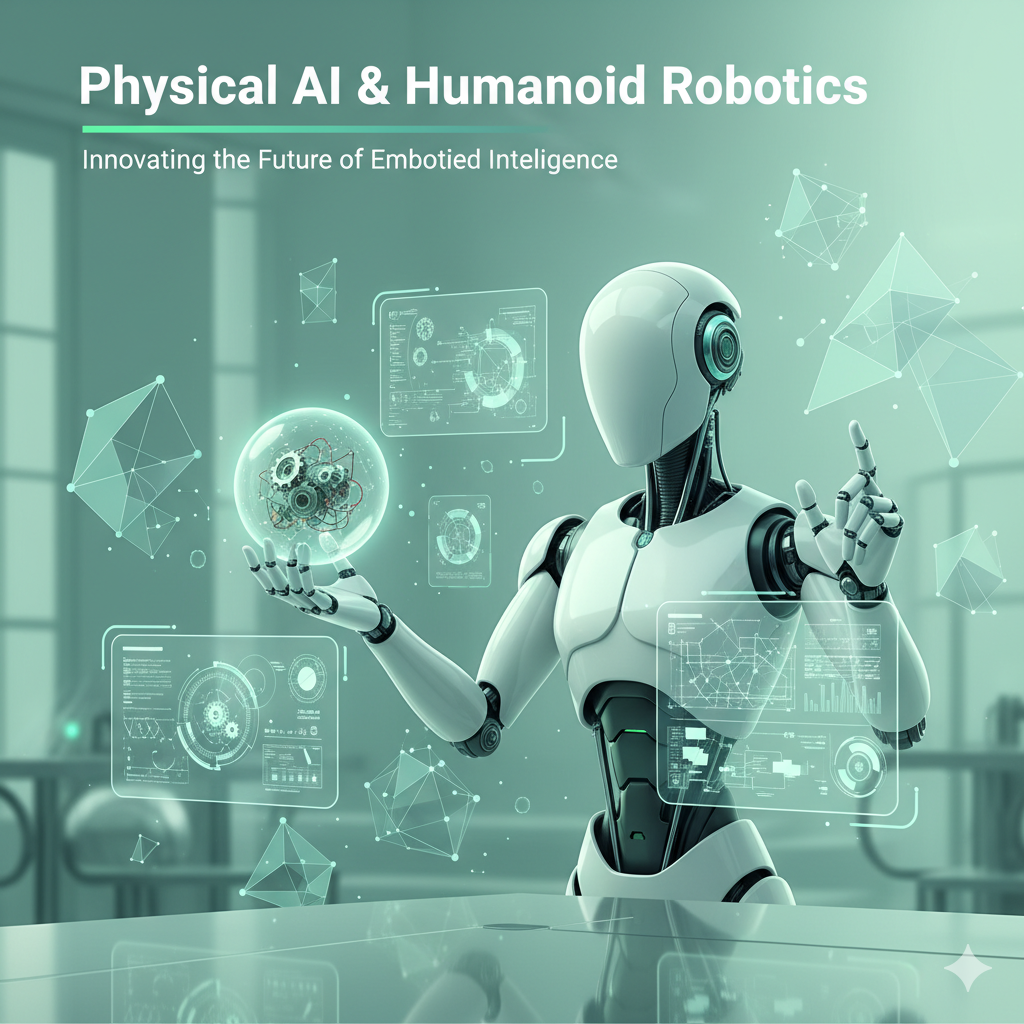
Explore All Chapters & Topics

Introduction to Physical AI
Explore the definition, historical context, and fundamental concepts of Physical AI and embodied intelligence. Learn about the perception-decision-action loop and why humanoid robots matter.
Foundations of Physical AI
Establish foundational knowledge required for understanding Physical AI and Humanoid Robotics. Learn core concepts, technical foundations, performance constraints, ethical considerations, and capstone project scope.

The Robotic Nervous System: ROS 2 Fundamentals
Learn ROS 2 as the middleware layer connecting sensors, perception algorithms, planners, and motor controllers. Master ROS 2 architecture, core concepts, and practical implementation using Python.
The Digital Twin: Simulation & Environment Building
Build virtual replicas of robots and environments using Gazebo, NVIDIA Isaac Sim, and Unity. Learn physics simulation, sensor modeling, and sim-to-real transfer techniques.

Perception, Multimodal Intelligence & Real-World Autonomy
Transform your humanoid into a world-aware agent. Build perception stacks with computer vision, SLAM, sensor fusion, and multimodal vision-language reasoning for autonomous operation.
Autonomous Robotics, Task Planning & Agentic Execution
Elevate your humanoid to a full autonomous agent. Learn navigation stacks, behavior trees, skill libraries, and LLM-guided decision-making for self-operated task autonomy.
Multi-Agent Robotics, Fleet Coordination & Distributed Intelligence
Expand from a single autonomous robot to teams and fleets. Learn multi-agent architectures, shared world models, fleet communications, task allocation, and swarm-style cooperation.
Deployment, Industrial Robotics & Real-World Integration
Move beyond simulation into industrial, real-world deployment. Learn hardware reliability, safety compliance, workflow integration, resilience, and field testing for production-ready systems.
What Makes This Book Different?
Complete Robotics Stack: Master ROS 2 middleware connecting perception, cognition, and control. Build distributed systems that scale from simulation to real hardware.
Digital Twins First: Test everything safely in Gazebo and NVIDIA Isaac Sim before touching expensive hardware. Learn sim-to-real transfer techniques used in industry.
Vision-Language-Action Integration: Transform natural language commands into motor sequences. Your robot understands "pick up the cup" and executes autonomously.
Embodied Intelligence Focus: Learn how physical constraints shape AI reasoning. Understand why humanoid form matters for human-centered environments.
From Single Robot to Fleet: Scale from autonomous humanoid to multi-agent coordination. Learn shared world models, task allocation, and swarm behaviors.
Industrial Deployment Ready: Master hardware reliability, safety compliance, workflow integration, and field testing for production-grade systems.
Why Read This Book
Hands-On Learning
Build a complete autonomous humanoid robot from scratch. Every chapter includes practical labs with real code, simulations, and deployment exercises.
Industry-Standard Stack
Learn ROS 2, Gazebo, NVIDIA Isaac Sim, and modern AI tools used by leading robotics companies. No toy projects—real production-grade skills.
From Theory to Reality
Master the complete pipeline: perception, planning, control, and deployment. Bridge the gap between AI research and physical robotics.
Future-Proof Skills
Stay ahead with embodied AI, multimodal reasoning, and LLM-guided robotics. Learn the technologies shaping the next decade of automation.